Monday, February 12, 2007

Saturday, February 10, 2007

Friday, February 09, 2007

Barry Spencer

A hand-built electrical panel for a vegetable oil deodorizer:

"The panel I built will control electrically-operated valves. It receives signals from sensors such as float switches (rising or falling liquid in a tank flips a switch), thermometers, etc. Logic circuits (computer chips) using custom-made software decide what to do under the current circumstances and send appropriate signals to electrically-operated valves that open and close to control the movement of liquids and gasses.

The computerized processors on the panel also receive and send signals to and from a Windows-based computer, so the plant operators can monitor and control operations. On the user interface there's an animated diagram of the processing equipment that shows which valves are open or closed, liquid levels in tanks, whether various pumps and fans are on or off, stuff moving through pipes, etc.

A vegetable oil deodorizer is a cylindrical, stainless steel tank. The tank is filled with vegetable oil, air is pumped out of the tank to form a high vacuum, and steam sent through coils of stainless steel tubing within the tank heats the oil to 464-518 F to vaporize the smelly compounds (aromatic oils, remaining free fatty acids, and traces of chemicals used in earlier refining steps) in the oil. Steam is also bubbled directly through the oil to absorb the smelly compounds, then the steam and smelly compounds are sucked away by the vacuum system."

"This one is on its side for transport":


"Looks like it's headed for the launch pad."

Wednesday, February 07, 2007

Hydromancy

The Rio Grande River forms a physical boundary between the United States and Mexico. This life source for the region has been made almost entirely inaccessible in El Paso because of a series of fences, canals, controversial irrigation diversions, and barriers that have been erected to prevent northward migration.

For SIMPARCH’s Hydromancy, water from the Rio Grande flows from a tank at the top of the rocky hillside outside of the Rubin Center. Gravity moves the water through three passive solar distillation units arranged in a descending formation on the hill. The stills use the energy of the sun to heat the water to the point of vaporization, the same process that forms clouds. The condensation that is formed is pure, drinkable water. It is transported down the hill and into the building via an elaborate, erected armature. The water is left to pool on the floor. That which has required human ingenuity and energy to create, lies in a puddle. The water is in its purest state – formless, still, its reflective presence spreading-accumulating at our feet. We engage with the water as a substance rather than as a commodity, relying on the weather to provide the proper conditions for flow. Contrary to the rhythms of nature, cloudy days result in very little distillation, whereas sunny days produce a regular stream.

Collaborator Steve Rowell provides an audio overlay to the installation. Sounds of this engineered water process are mixed with field recordings of the border - dissolving the physical walls of the gallery, revealing an acoustic interpretation of the landscape beyond. The field recordings were made at various points along the river as well as along the invisible, land border and in many cases with one half of the microphone in the US and the other half in Mexico. The division between nations becomes reduced, distilled, by an objective experience - the listener’s ability (or inability) to perceive minute differences in stereo sound.

Water here on the border is scarce and water usage is divided unequally between the two countries. El Pasoans use on average twice as much water per day as their southern neighbors. In Juarez, water is provided without restriction to large maquiladoras, while many colonias in the periphery of both cities have little or no access to drinkable water for daily needs. In the global arena, some 1.2 billion people lack access to clean water, twice that number have no sanitation and most of the world will not have enough water within 30 years.

Water has played a role in nearly all cultures as a symbol of purity and life but the waters in the Rio Grande, long polluted by industry and agriculture in the region, are dirty and contaminated. We have come to expect water to be clean and drinkable, yet we pollute it with all manner of human and industrial waste. Water has become impure, and in need of cleansing, removed from its physical and metaphorical role as a cleansing agent of bodies and souls.

This work by SIMPARCH is inspired in part by the writings of Ivan Illich who urged post-industrial society to critically assess the role of technology in everyday life. In his writings on the subject of water, Illich speaks of the difference between water as a compound or commodity, in need of treatment and in the service of technology, and water as a substance with a sacred role in ceremonies such as baptism His writings and SIMPARCH’s installation invite us to reengage with water as a life force.


Tuesday, February 06, 2007

Monday, February 05, 2007


(Coming soon to a theater near you!)

Friday, February 02, 2007

Return to the Balloon Track: Geologic Setting and Late Holocene Land Use

College of the Redwoods, Feb. 5, 2007, Room PS 113, 11:30–12:30


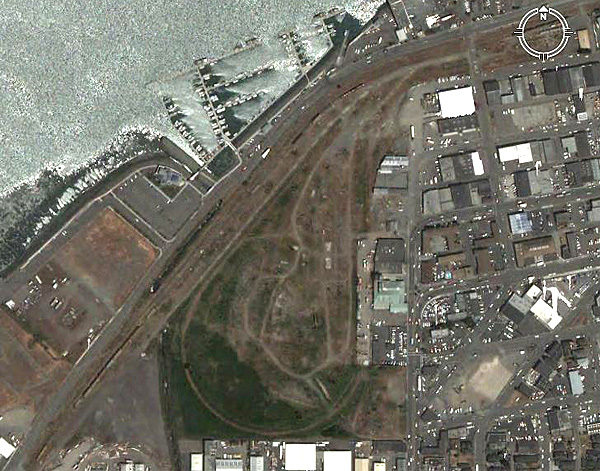
Above: the Balloon Track in 1952 and as it appears from "Google Earth" today

CR Geology Professor Dave Bazard will present an overview of the geologic setting and associated land use of Eureka's controversial former train yard. In 2001, he and other college faculty participated in a multidisciplinary study of the site, with "The Balloon Track Project: An Exploration of Misintentional Landscape Use”, exhibited at Humboldt State University's First Street Gallery. Dave's colloquium presentation will revisit that former investigation and elaborate on the subsurface geology and contamination history of the site.
A really good place to eat in Tijuana:

Monday, January 29, 2007

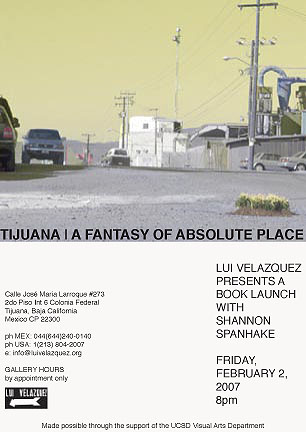
Lui Velazquez

My Barbarian

"Pagan Rights Part III" (2006)

This performance collective satirizes my locally endemic Hippie/New Age culture better than anyone else I know...

Thursday, January 25, 2007

Wednesday, January 24, 2007

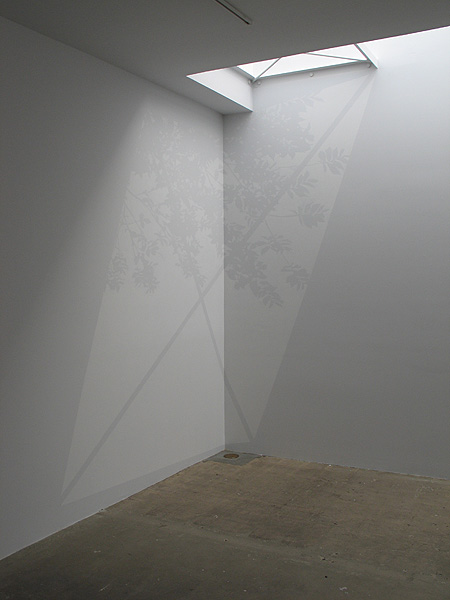
Mary Temple at Sandroni Rey (Culver City)


(Though they look like sunlight, these images are actually very delicately executed wall paintings.)

Sunday, January 21, 2007

Saturday, January 20, 2007

Friday, January 19, 2007

Wednesday, January 17, 2007

Tuesday, January 16, 2007

Monday, January 15, 2007

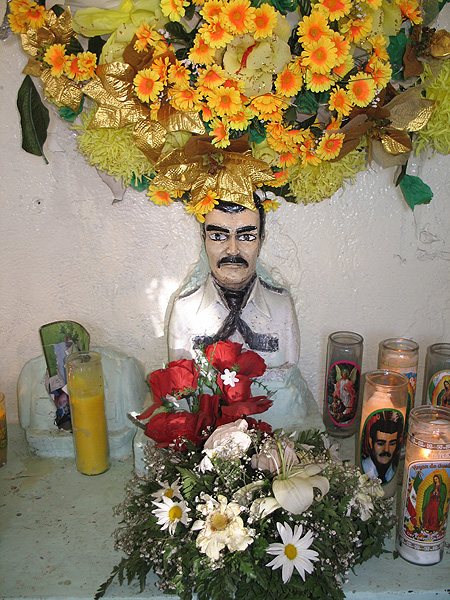
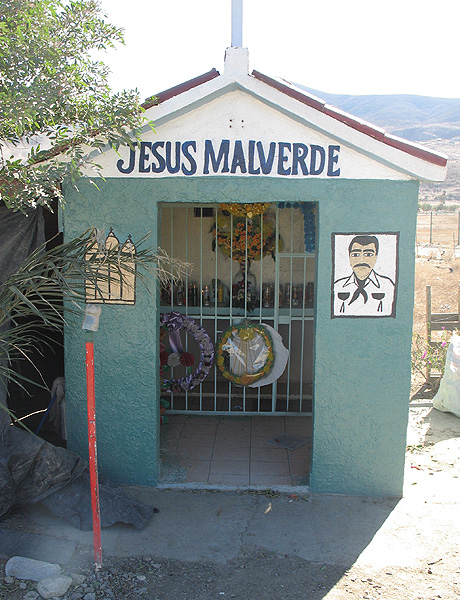
Jesus Malverde (click aqui)

"The Narco Saint"

Friday, January 12, 2007

Rellenos Sanitarios de Tijuana:

Thursday, January 11, 2007

Wednesday, January 10, 2007

Sunday, January 07, 2007

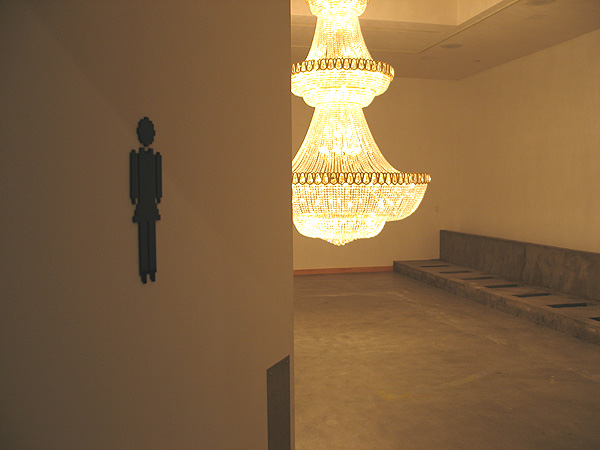
Song Dong and Yin Xiuzhen at the Redcat Gallery (Los Angeles)

"Restroom M and Restroom W", 2006


Song Dong
Song Dong (detail)

Wednesday, January 03, 2007

Sister Rosetta Tharpe

A totally cool video I found on another local blog...

Tuesday, January 02, 2007

Monday, January 01, 2007


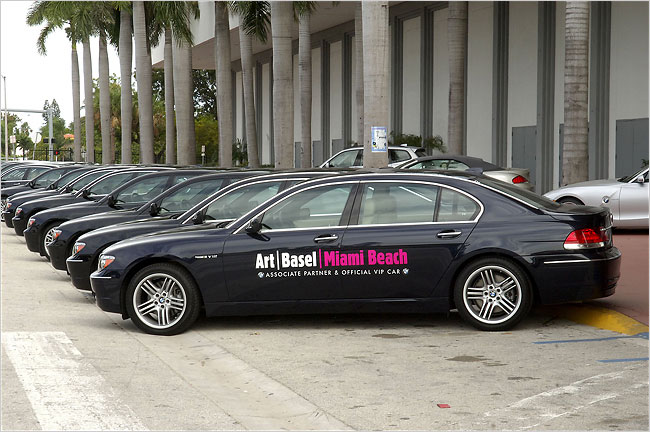
New York Times, December 24, 2006
When Art Stayed Too Long at the Fair
By HOLLAND COTTER

WITH so much hype generated, so much cash exchanged and so much new product churned out, how did the 2006 New York art season end up such a piddling affair?

The city’s big museums are partly to blame, as their high-profile exhibitions abandoned any pretense of offering critically challenging views of the past. Boilerplate shows — at the Met, “Cézanne to Picasso,” “Americans in Paris, 1860-1900” and “Glitter and Doom: German Portraits From the 1920s”; the Whitney’s “Picasso and American Art”; and “Spanish Painting From El Greco to Picasso” at the Guggenheim — went to the expense of assembling scads of sexy pictures, then not only failed to tell us anything fresh, but also reinforced every art-historical cliché we cherish.

This is the museum treating its audience like kids in a candy store rather than like adults who can accept that art is as poisonous as it is sweet, that it tells as many lies as truths.

Once, we might have turned to contemporary art for alternative energy. But in 2006, it just complacently provided blasts of commercial triumphalism. The art fair matured into a kind of joke, a revenge on everything 1990s, with parties replacing politics and skill valued over ideas. In an age of universal competence and a democracy of art-schooled polish, criticism could have cast a cold eye on the field, but it took a pass on ethical issues and stuck to product placement instead.

Yes, the 2006 boom art market brought benefits — the most important probably being that more New York artists could make a living from their work. But here, as in all else, the art world is just the real world writ small: the major share of profits ended up in a very few privileged hands.

But what’s the point of kvetching? Art has always been attracted to money, and vice versa. And it has almost always been a servant to the elite, an advertisement for the status quo. Every so often art forcefully and collectively proposes alternative models — but 2006, at least as played out in New York, was not such a time. Short of an economic bump, we’re not likely to see it happen soon.

So maybe we should stop pestering art to be some utopian undertaking, some zone for alternative thoughts and forms, and just enjoy it for the high-energy, no-impact game of trivial pursuit it has become.

Sunday, December 31, 2006

Javier Telles

One Flew Over the Void (Bala Perdida), 2005

Friday, December 29, 2006

Thursday, December 28, 2006

Wednesday, December 27, 2006

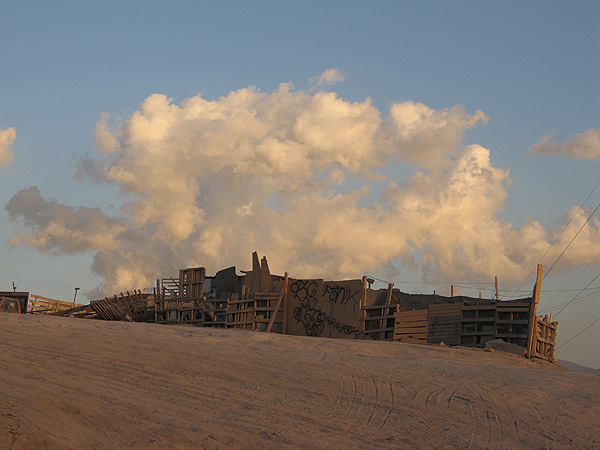
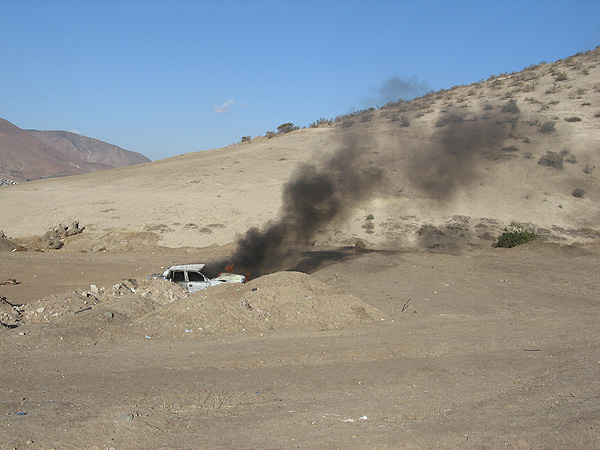
Images from Jesse's recent road trip: